
Gambling Laws in India: The Public Gambling Act of 1867 vs. State-by-State Jurisdictions
India’s gambling regulatory framework represents a complex tapestry of colonial-era central statutes, constitutional divisions of power, and evolving state-specific legislation. The foundational Public Gambling Act of 1867 serves as the baseline federal framework, but state governments retain sovereign authority over gambling under the Seventh Schedule of the Indian Constitution. A detailed comparative analysis of federal provisions, state exemptions in Goa and Sikkim, and recent digital IT rules reveals how the Indian gaming market operates in practice.
The Colonial Precedent: The Public Gambling Act of 1867
The primary central statute governing gambling in India remains the Public Gambling Act of 1867, enacted during British colonial administration. This pre-independence law penalizes the operation of and visiting of “common gaming-houses” where games of chance are played for profit.
The central statute was drafted more than a century before the advent of the internet, personal computers, and digital payment rails. Consequently, the Public Gambling Act contains zero references to online gambling, digital betting exchanges, or server-hosted casino software.
The primary legal distinction established by Section 12 of the Act isolates “games of mere skill” from statutory prohibitions. Under this critical statutory carve-out, the operational penalties of the Act do not apply to any contest decided primarily by skill rather than chance.
While the central Act originally applied across the territories, it now functions primarily as a model default statute. States retain the constitutional mandate to adopt, amend, or entirely repeal the central Act within their respective territorial jurisdictions.
Constitutional Federalism: Entry 34 of the State List
The Indian Constitution establishes a three-tiered legislative division between the Union Parliament and State Legislative Assemblies. Under Article 246 and Entry 34 of List II (the State List) in the Seventh Schedule, states possess exclusive legislative power over “Betting and gambling”.
Because betting falls squarely under state competence, India does not maintain a uniform national gambling code. Each state legislature decides whether to ban wagering entirely, permit selective land-based gaming, or regulate real-money digital platforms.
The central government retains jurisdiction over telecommunications, foreign exchange, and interstate electronic trade under the Union List. Therefore, the Union Ministry of Electronics and Information Technology (MeitY) regulates the digital transmission of online games, while states govern the act of wagering itself.
This overlapping jurisdictional matrix produces sharp regulatory contrasts across state borders. A gaming activity legally permitted and licensed in one state may constitute a cognizable criminal offense mere kilometers away across a state border.
| Jurisdiction / Statute | Legal Framework | Land-Based Casinos | Online Casino Gaming | Skill vs. Chance Approach |
| Federal (Public Gambling Act 1867) | Central model statute | Prohibited in common gaming-houses | Silent on digital internet gaming | Section 12 protects games of mere skill |
| Goa, Daman and Diu Act (1976) | State-level licensing scheme | Permitted on offshore vessels and in 5-star hotels | Electronic gaming terminals permitted | Regulated via official state licensing |
| Sikkim Regulation Act (2008) | Regulated licensing model | Permitted in designated brick-and-mortar resorts | Intra-state online casino licenses issued | Controlled intranet intranet server delivery |
| Telangana Gaming Act (Amended) | Complete prohibitionist stance | Strictly illegal | Comprehensively banned (all real-money games) | Skill exception abolished for monetary stakes |
| Tamil Nadu Gaming Act | Restrictive statutory regime | Strictly illegal | Rummy and poker face ongoing judicial dispute | High Court maintains skill-based protection |
Progressive Exceptions: Brick-and-Mortar Licensing in Goa and Sikkim
A small group of Indian states has departed from standard prohibition by creating regulated, revenue-generating casino environments.
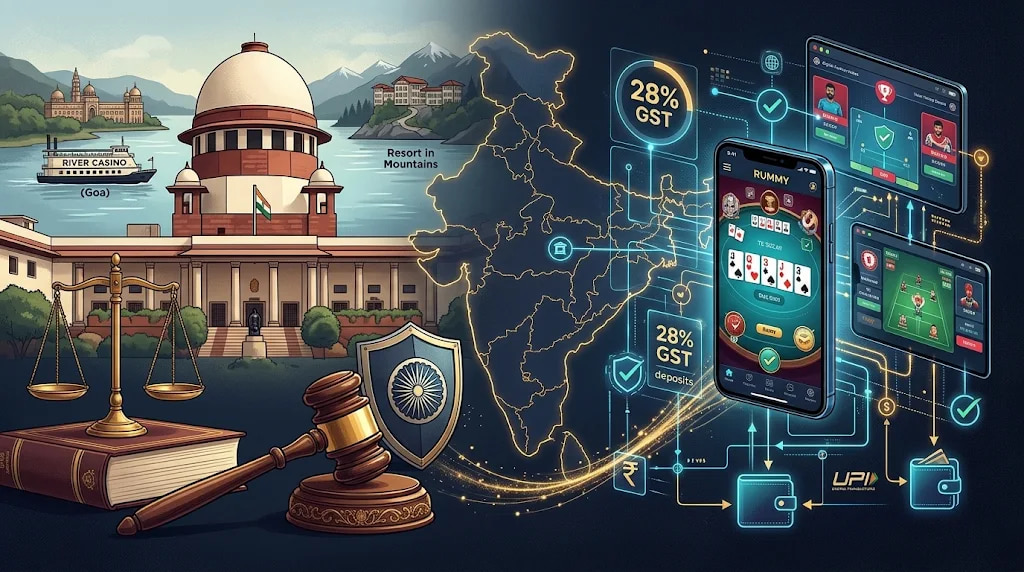
Goa represents the hub of Indian land-based casino entertainment under the Goa, Daman and Diu Public Gambling Act of 1976. In 1992 and 1999, the state amended its statutes to permit electronic gaming in five-star hotels and live table games aboard offshore vessels.
Vessels anchored along the Mandovi River, such as Deltin Royale and Big Daddy, operate live-dealer roulette, baccarat, and blackjack under formal state permits. The state levies substantial license fees and entertainment taxes that supply a major share of Goa’s annual tourism revenue.
Sikkim advanced the regulatory boundary further through the Sikkim Regulation of Gambling (Amendment) Act of 2005 and subsequent statutes. In 2008, Sikkim became the first Indian state to legalize and license physical casino gaming within designated five-star resort properties.
Sikkim subsequently introduced the Sikkim Online Gaming (Regulation) Act of 2008 to license digital casino and sports betting. However, these digital licenses restrict operators to providing online games through intranet terminals located exclusively within the territorial borders of Sikkim.
Skill Versus Chance: The Supreme Court Test
The legality of real-money gaming in India hinges on the judicial demarcation between “games of skill” and “games of chance.”
The Supreme Court of India laid down the definitive standard in the landmark 1957 case State of Bombay v. R.M.D. Chamarbaugwala. The court held that competitions involving substantial skill are commercial business activities protected under Article 19(1)(g) of the Constitution, shielding them from anti-gambling statutes.
In the 1968 case State of Andhra Pradesh v. K. Satyanarayana, the Supreme Court applied this doctrine directly to the card game Rummy. The apex court declared Rummy to be a game predominantly of skill, noting that card distribution requires memorization, sequencing, and strategic discards.
The Supreme Court reaffirmed this approach for horse-race betting in 1996 in K.R. Lakshmanan v. State of Tamil Nadu. The judges ruled that analyzing pedigree, jockey skill, and track conditions transforms race wagering into a constitutionally protected skill contest.
By contrast, three-card brag (Teen Patti), Andar Bahar, and casino slot machines lack a predominant skill component. Because chance governs outcomes in Teen Patti, Indian courts classify it as pure gambling subject to state prohibitions and penal provisions.
Southern Divergence: Prohibition in Telangana, Andhra Pradesh, and Tamil Nadu
While western and northeastern states experimented with selective regulation, several southern states enacted sweeping prohibitions against all real-money games.
Telangana amended the Telangana Gaming Act in 2017 to eliminate the traditional exemption for games of skill. The amended law categorizes any digital game played for financial stakes as an illegal gambling offense, regardless of player skill.
Andhra Pradesh followed with parallel statutory amendments in 2020, imposing strict bans on real-money online rummy, poker, and card games. Violations carry custodial sentences for platform operators and monetary fines for individual online participants residing in the state.
Tamil Nadu attempted similar absolute prohibitions by enacting ordinances and statutes targeting online rummy and online poker. However, the Madras High Court repeatedly struck down blanket state prohibitions, ruling that criminalizing established skill games violates constitutional protections.
This ongoing tension between state legislative crackdowns and constitutional jurisprudence creates a volatile legal environment. Platform operators routinely geofence their software to block users located within Telangana, Andhra Pradesh, and Assam to prevent state criminal liability.
The Online Grey Market and Federal IT Intermediary Rules
The intersection of central technology mandates, currency controls, and offshore operators shapes the contemporary online casino environment in India.
Because central laws do not explicitly prohibit offshore operators, hundreds of international online casinos accept Indian players via offshore licensing from Malta and Curaçao. The central Foreign Exchange Management Act (FEMA) regulates cross-border currency transfers, prompting offshore operators to adopt domestic Unified Payments Interface (UPI) gateways.
To establish centralized oversight over digital platforms, the central government notified the Information Technology (Intermediary Guidelines and Digital Media Ethics Code) Amendment Rules in 2023. These MeitY rules introduce registered Self-Regulatory Bodies (SRBs) to verify permissible real-money online games that contain no wagering on outcomes.
Furthermore, India overhauled its taxation structure by applying a 28 % Goods and Services Tax (GST) across all real-money online gaming. This uniform 28 % GST applies to the total entry deposit value, reinforcing federal administrative oversight over domestic digital operators.
Strategic Outlook for Indian Gaming Jurisdictions
India’s gaming legal landscape continues to evolve through the friction between 19th-century colonial prohibitions and 21st-century digital economies. While state-level bans persist across several conservative jurisdictions, states like Goa and Sikkim demonstrate the economic value of regulated licensing frameworks. As central authorities tighten fiscal, tax, and digital compliance standards, the Indian gaming ecosystem steadily transitions toward formalized oversight across both skill and regulated chance sectors.